|
Emergency Contingency Procedures ECP Search & Rescue and Towage |
Doc No.: ECP 07-00
Revision: 01 Date: 15 Oct 2024 Issued by: DPA Approved by: MD |
7.1. SEARCH & RESCUE
7.1.1. Initial Actions
IAMSAR, Vol. III "Guidelines for ships for search and rescue at sea" gives extensive information on how to organize a search and rescue action. Below is the general advice to ship master for initial actions and preparations under such circumstances.
| sr | Action | Y/N |
|---|---|---|
| 1 | Immediately after having received message about a distress situation, establish radio contact on all distress frequencies and channel 16 to receive possible signals from survivors. | |
| 2 | Ensure that company/Charterers are notified before commencing such operation, if practical. | |
| 3 | Make immediate contact with the nearest coastal radio station while heading for a distress position. State the ship's name, position, speed and actions that will be initiated. Master should also request for further advice and guidelines. | |
| 4 | Complement should be organized in such a way to establish a continuous lookout from as many posts as possible, if required. | |
| 5 | Make ready all rescue equipment (as per the type of rescue method) as well as maximum illumination in case of night action. | |
| 6 | If more ships are underway to the area try to establish co-operation with the other ships in deciding a CSS (Co-coordinator Surface Search) until professional units take command of the action. |
7.1.2. Rescue of Survivors
| sr | Action | Y/N |
|---|---|---|
| a. General | ||
| 1 | Prepare a plan before a rescue action is initiated after carefully examining the circumstances time and situation permitting. | |
| 2 | If the survivors are not in immediate danger, and the existing conditions make the rescue action hazardous, consider the possibility of postponing the action until weather conditions have improved. | |
| 3 | Consider postponing rescue operation until daylight or until suitable rescue units arrive in such case. | |
| 4 | If possible, try to establish communication with the survivors for information about the condition and circumstances. | |
| 5 | Maneuver so as to shelter the survivors until the rescue action is initiated. | |
| 6 | If participating as a unit in an organized search action, notify immediately RCC or RMC (Rescue Mission Coordinator) and OSC (On Scene Coordinator) when the survivors are localized. The coordinator will consider the rescue methods and direct that unit(s) in the area best suited under the given circumstances. | |
| b. Rescue from a Wreck | ||
| 1 | Direct transfer of survivors from a wreck by use of a breeches buoy to the ship is possible only in favorable weather conditions when the relative motion between the vessels is negligible. | |
| 2 | Consider using the lifeboat under such conditions, which is always preferred. | |
| 3 | Try to determine the drift/current before launching a lifeboat, preferably by going around the wreck. | |
| 4 | Try to establish communication with the survivors to decide the method of rescue, so that they may also contribute actively in the planned action. | |
| 5 | Decide beforehand whether the ship should lie to windward of the wreck, so that the rescue boat is sheltered underway to the wreck, or vice-versa. | |
| 6 | Ensure enough lines and rope, line thrower and heaving lines are brought along with the lifeboat for possible use during the transfer of the survivors to the boat. | |
| 7 | Consider risk of fire before the line thrower is used. | |
| 8 | If it is too difficult & hazardous to launch a boat, a line thrower can be used to make connection with the wreck. The survivors should be instructed to haul a raft up to the wreck. The ship must maneuver to leeward of the wreck. | |
| 9 | If it is not possible to establish a line connection or operate to leeward of the wreck, consider releasing a raft and, by the aid of towing lines, maneuver this towards the wreck from a windward position. The raft must be secured by solid lines, as the normal painter will not withstand loads. | |
| c. Rescue from a Lifeboat | ||
| 1 | Consider maneuvering to windward of the lifeboat and then drift down towards it. | |
| 2 | Ensure all preparations for transfer are made before going into position. Survivors in the lifeboat may not provide cooperation from their side due to seasickness and exhaustion. | |
| 3 | Ensure nets are hung over the sides as much of the length as possible. | |
| 4 | A boat line should be kept ready from forward to aft to keep the craft in position during the transfer. | |
| 5 | In extreme cases, an inflatable raft may be used as a platform, if required, for the safety of survivors and the ship's crew. | |
| 6 | Crew with lines and buoys should be posted to help survivors who may fall overboard during the transfer. | |
| 7 | Consider sending some of the ship's crew to assist the survivors, safety of own crew and situations permitting. | |
| d. Rescue from the Water | ||
| 1 | Consider using a lifeboat since survivors in the sea are in imminent danger, and the quickest possible rescue is required. | |
| 2 | If conditions make it difficult to use a boat, consider using a net and someone, secured by lines and wearing survival suits, jumping into the sea to assist the survivors, safety of own crew and situations permitting. | |
Important Note: Company should be kept informed of all activities and developments so as to keep Charterers / consignee & next port agents informed.
7.1.3. Follow up
(a) Reporting procedures as mentioned in chapter 9.0 to be followed up. Company and all concerned authorities as per the geographical area should be informed in case of rescue of survivors.
(b) Ship shall be advised by the company for further actions.
7.1.4. Record Keeping
Master must ensure that a chronological record of all events & communications is logged in respective log books.
7.2. TOWING
Note: Below instructions are in addition to the Class approved ETB which should be referred to for any situation involving Towing operations.
(a) There exists an unqualified obligation to assist persons in distress. However, there are no such obligations for Master to assist in the salvage of a ship and its cargo, including towing.
(b) If in an imminent distress situation, the best solution appears to be to attempt a towing operation, the Company must be notified immediately, so that hull underwriters and Charterers / shipper's agreement may be obtained. If there is no danger to human lives, the approval of the Company, shippers and hull insurance must be obtained before the towing operation is started.
(c) Similarly, a ship herself can be in a situation (due to engine or steering failure) so as to require towage from another ship or a salvage tug. Depending on damage, decide whether to be towed from ahead or from astern.
7.2.1. Initial Action
(a) Try to make early communication with towing vessel and decide what preparation to be made.
(b) If forward winch power not available, get tackles ready to heave in the towline. Alternatively, the towing vessel's winch can be used.
(c) Keep line throwing apparatus ready for use (On tankers, cargo tanks conditions (gas-free / inerted) should always be kept in mind and considered before using LTA).
(d) Enough manpower to be available and equipment like heavy shackles / hammers / crowbars, etc. to be ready.
(e) Keep messengers of different sizes and adequate length ready.
(f) It is advisable to keep one messenger line permanently between both vessels so that in case towline parts, valuable time is not lost in passing another messenger line.
(g) Basic towing safety, including emergency release procedures to be well explained and understood.
(h) Lights and shapes to be kept ready for display.
(i) If possible, a drawing identifying location and capacity of strong points shall be kept handy.
7.2.2. Checklist for Towing
Some actions to be taken by Master of disabled vessel and PIC of towing vessel:
| 01 | Establish early communication between disabled vessel, local authorities, and the towing vessel to exchange information and agree on preparations to be made. Maintain radio communication while connecting tow line & during emergency towing. | |
| 02 | Ensure that radio broadcast warnings are periodically transmitted by the disabled vessel or towing vessel, as appropriate. | |
| 03 | Ensure that appropriate lights and shapes are displayed for the vessel not under command and for the towing vessel. | |
| 04 | Ensure that the disabled vessel’s position plot is maintained and updated frequently, and that set and drift are calculated. This shall be communicated to the local authorities and the assisting towing vessel(s). | |
| 05 | Determine whether the disabled vessel should be towed from the bow or the stern to minimize damage or improve handling under tow. | |
| 06 | Determine the most suitable strong points for tow line connection, taking into consideration the safe working load and breaking strength of tow lines. | |
| 07 | Consider size, horsepower, and maneuverability of towing vessel when deciding upon towing arrangement. | |
| 08 | If available, ensure that electrical power, hydraulic pressure, compressed air, or steam is available for deck machinery such as windlass and winches. | |
| 09 | Choose fixed fairlead or chock with the largest possible radius of curvature for the tow line or bridle to ensure optimum maneuverability while under tow. | |
| 10 | Consider the means for transferring tow line between the disabled vessel and the towing vessel, including use of LTA. | |
| 11 | Ensure that proper personal protection equipment is worn by personnel involved in towing operations. Ensure that personnel stay out of the line of pull of the towline pennant, and bridle legs. | |
| 12 | Ensure that proper tools are readily available near tow line or bridle connecting point. | |
| 13 | Before commencing the tow, the master of the disabled vessel and PIC of towing vessel should communicate the towing plan clearly and frequency of communication. | |
| 14 | If the disabled vessel has steering in operation, then vessel’s rudder may be used to maintain a steady course astern of the towing vessel. | |
| 15 | If the vessel being towed does not have steering, the rudder should be secured amidships to minimize damage from the rudder slamming into the hull in heavy sea. |
7.2.3. Emergency Towing Procedures
(a) Towing from ahead
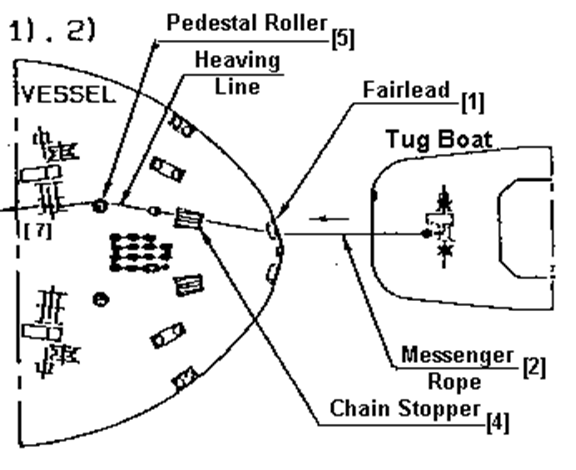
Case - 1: Using Tugboat’s Power
Case - 1: Using Tugboat’s Power
(i) The heaving line of the vessel to be thrown to the tugboat through the fairlead [1]. And the outboard end of the heaving line is connected to the messenger rope [2] of tugboat. Then pull the heaving line and the messenger rope on board the vessel.
(ii) The heaving line and the messenger rope [2] once on the vessel is to be returned to the tug through the chain stopper [4], pedestal roller [5] and fairlead [6] which shall be heaved back by tug using her warping drum [7].
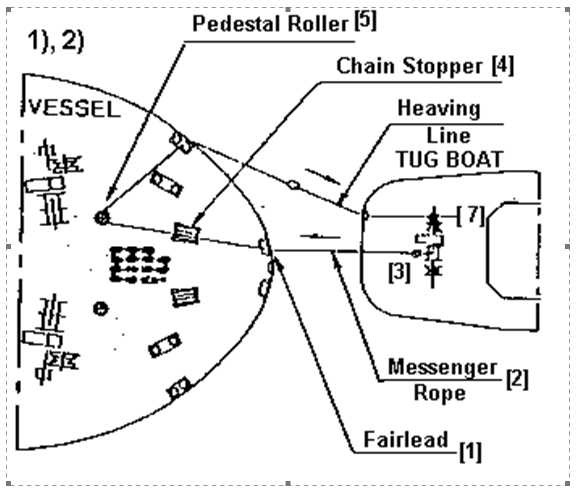
(iii) Towing rope [3] of the tugboat shall be heaved up on the vessel due to continuous winding of the messenger rope [2] by the tug’s warping drum [7]. This towing rope shall pass through fairlead [1] & chain stopper [4]. Once sufficient length of towing rope on board the vessel, it should be secured near the chafing chain [9] with the help of lashing rope [8].
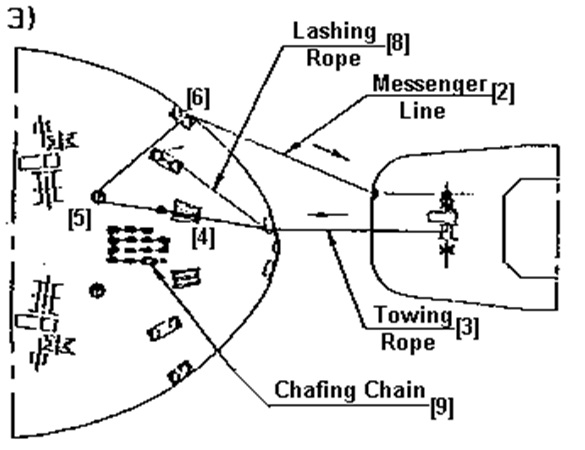
(iv) Disconnect the messenger rope [2] from towing rope [3]. Secure eye (end) of towing rope [3] and forward end of chafing chain [9] using bow shackle.
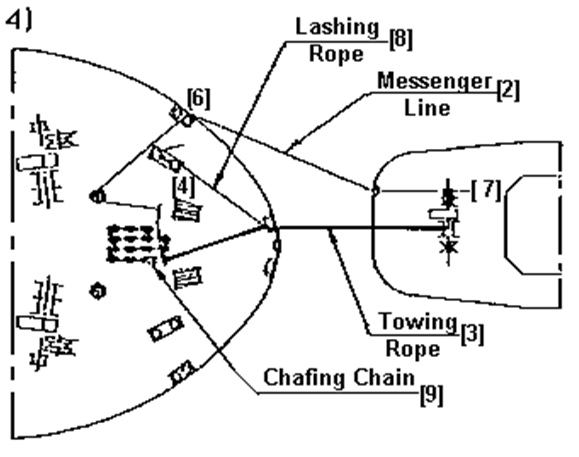
(v) The messenger rope [2] to be connected to common link at the other end of chafing chain [9].
(vi) Now messenger rope [2] shall be heaved up by tugboat using warping drum [7] and lead the chafing chain [9] to chain stopper [4].
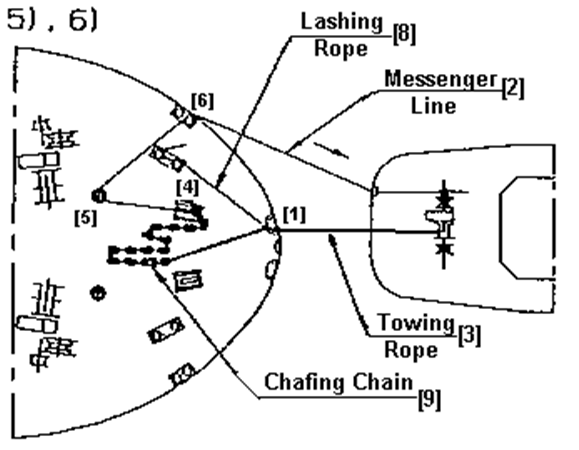
(vii) While heaving the messenger rope [2], the chafing chain [9] shall come to a suitable position for setting on the chain stopper [4]. Put the stopper in this position.
(viii) The lashing rope [8] for towing rope [3] is carefully released. Thereafter towing rope [3] to be slowly heaved up by the towing winch [10] of the tugboat.
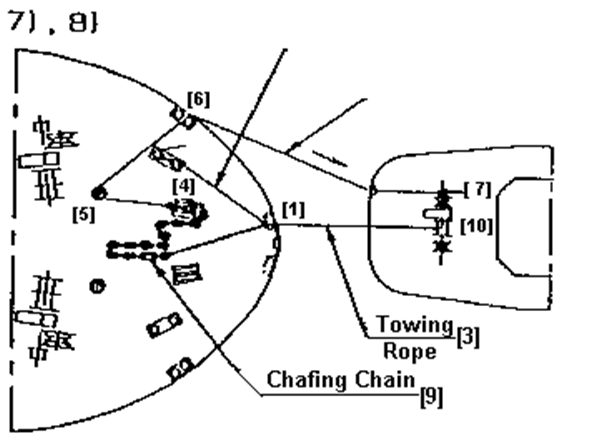
(ix) When the chafing chain [9] and towing rope [3] becomes tight, towing operation can be started.
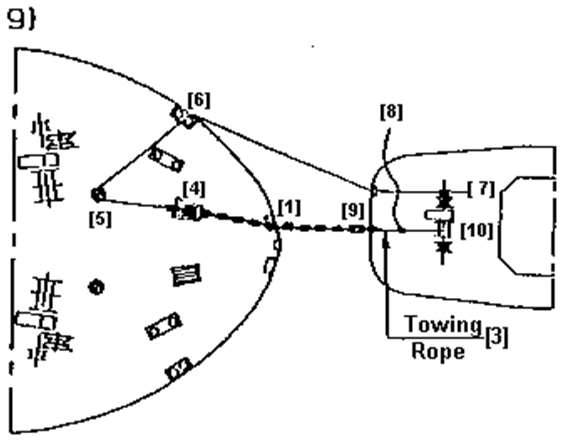
Case - 2: Using Vessel’s Mooring Power
(i) The heaving line of the vessel to be thrown to the tugboat through the fairlead [1]. Outboard end of heaving line shall be connected to the messenger rope [2] of tugboat.
(ii) Heave up the heaving line and the messenger rope on the vessel by the ship’s winch [7] through the chain stopper [4], pedestal roller [5] and the fairlead [1].
(iii) While heaving up the messenger rope [2] by the winch [7], pull up the towing rope [3] on the vessel through the fairlead [1] and chain stopper [4] till sufficient length of towing rope is on board. Thereafter towing rope [3] should be secured lashed by lashing rope [8].
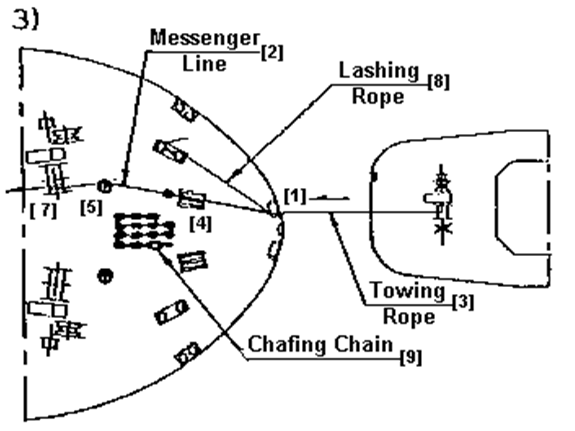
(iv) Disconnect the messenger rope [2] from towing rope [3]. Forward end of the chafing chain [9] to be connected to the end (eye) of towing rope [3] using a bow shackle.
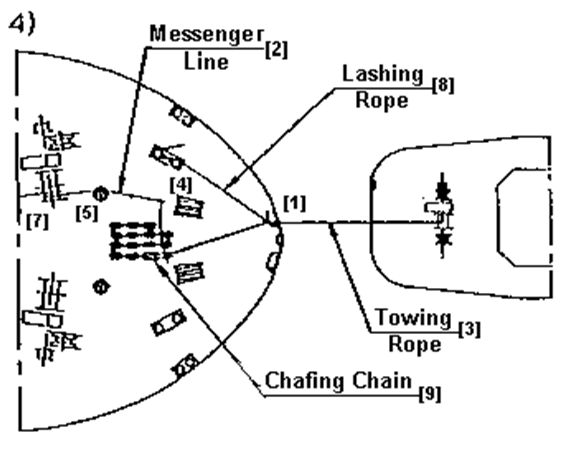
(v) The messenger rope [2] to be connected to common link at the other end of chafing chain [9].
(vi) Heave up the messenger rope [2] by the winch [7] of vessel and lead the chafing chain [9] through chain stopper [4].
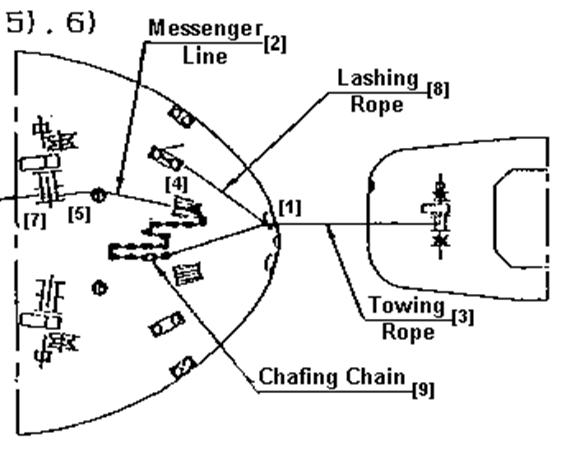
(vii) While heaving the messenger rope [2], the chafing chain [9] shall come to a suitable position for setting on the chain stopper [4]. Put the stopper in this position.
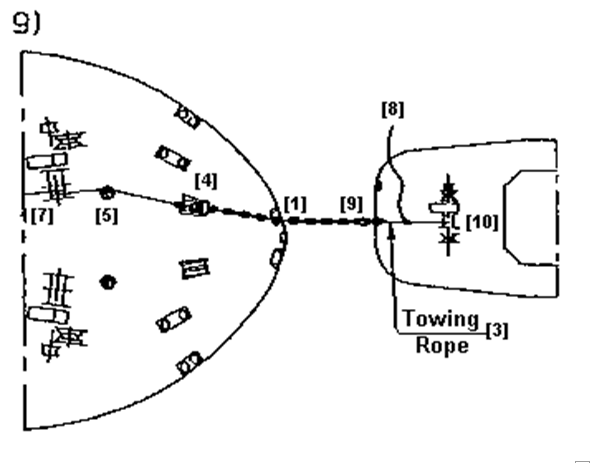
(viii) The lashing rope [8] for towing rope [3] is carefully released. Thereafter towing rope [3] to be slowly heaved up by the towing winch [10] of the tugboat.
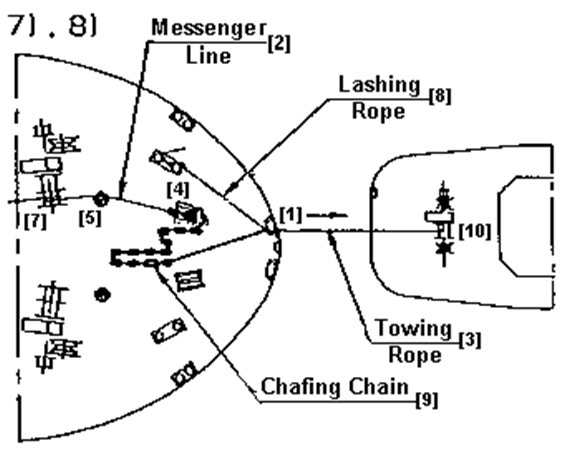
(ix) When the chafing chain [9] and towing rope [3] becomes tight, towing operation can be started.
(b) Towing from stern
(i) Remove the lock pins [2] for clip handle [3] and lever [4] of the pick-up box.
(ii) Turn the lever [4] counterclockwise. Confirm that the pick-up gear will drop of its own weight into the water.
(iii) Confirm that the self-igniting light [6] is lighted up when in water.
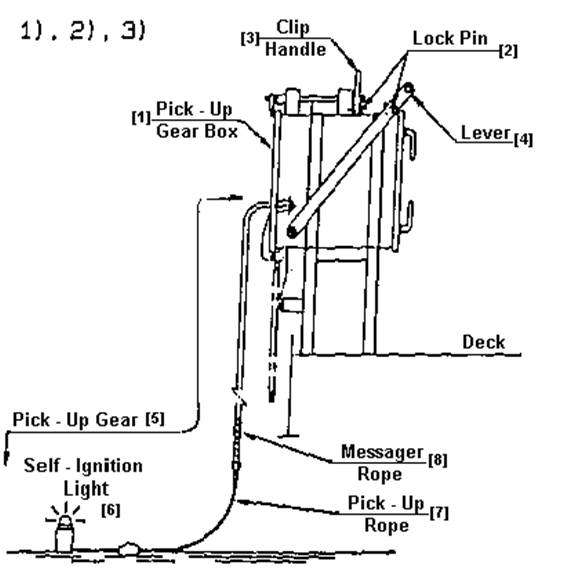
(iv) The tugboat shall haul the pick-up gear [5] from the water and heave up the pick-up rope [7].
(v) Tug shall heave up pick-up rope [7], and messenger rope [8] using her winch [12].
(vi) Subsequently the pennant wire [9] is drawn out from the vessel. Before the pennant wire [9] reaches off the sea, the tugboat to return to take the pennant wire [9].
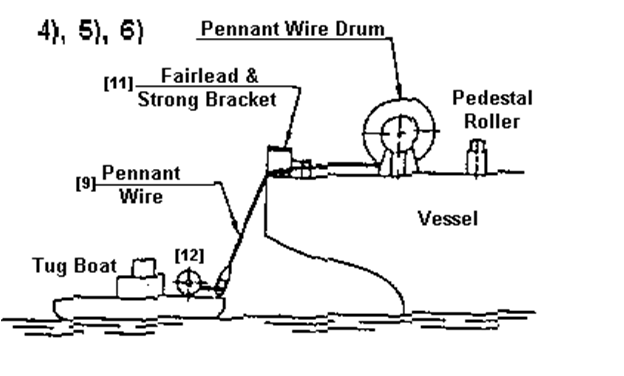
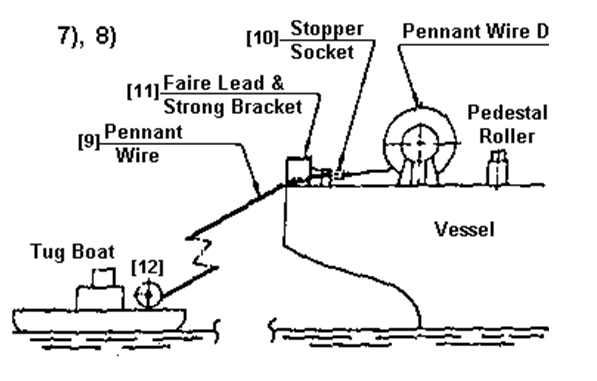
Tug shall stop heaving the messenger rope and connect C type socket of the pennant wire [9] by the lashing device. The messenger rope [8] shall be disconnected from the pennant wire [9] now.
(vii) Tugboat shall move ahead and pull out the pennant wire [9] until the stopper socket [10] of pennant wire [9] comes in contact with fairlead & bracket [11].
(viii) Towing operation can be started now.
7.2.4. Precautions during Towing
(a) Bow or stern as applicable to be manned at all times - weather permitting.
(b) Towline to have enough slack to lessen stress on towline. At all times it should be well below water level.
(c) Chafing of towline at closed lead to be kept to minimum. This may be done by applying grease / veering or shortening towline, etc.
(d) Continuous communication / no action should be taken regarding navigation/ engine movement without informing other Master.
(e) If engine failure, try to disengage propeller from shaft and let it revolve freely. This will reduce resistance. If not possible to disengage propeller, engage in turning gear to avoid damage.
(f) If there has been a steering failure, try to lock rudder amidships, otherwise it will hamper towing.
(g) Alteration of trim within safe stress limits can improve maneuverability. Try to change trim by transferring weights rather than adding weights as it will stress on towline.
Note 1: These are general procedures. Much will depend on equipment available and prevailing weather conditions.
Note 2: Also refer to the "Peril at Sea & Salvage" guide on board.
Note 3: Printout of ETA procedures shall be displayed on the bridge for quick reference.